

Goal26 Research Examines AI and Human Predictions Across More Than 50,000 FIFA World Cup 2026 Brackets
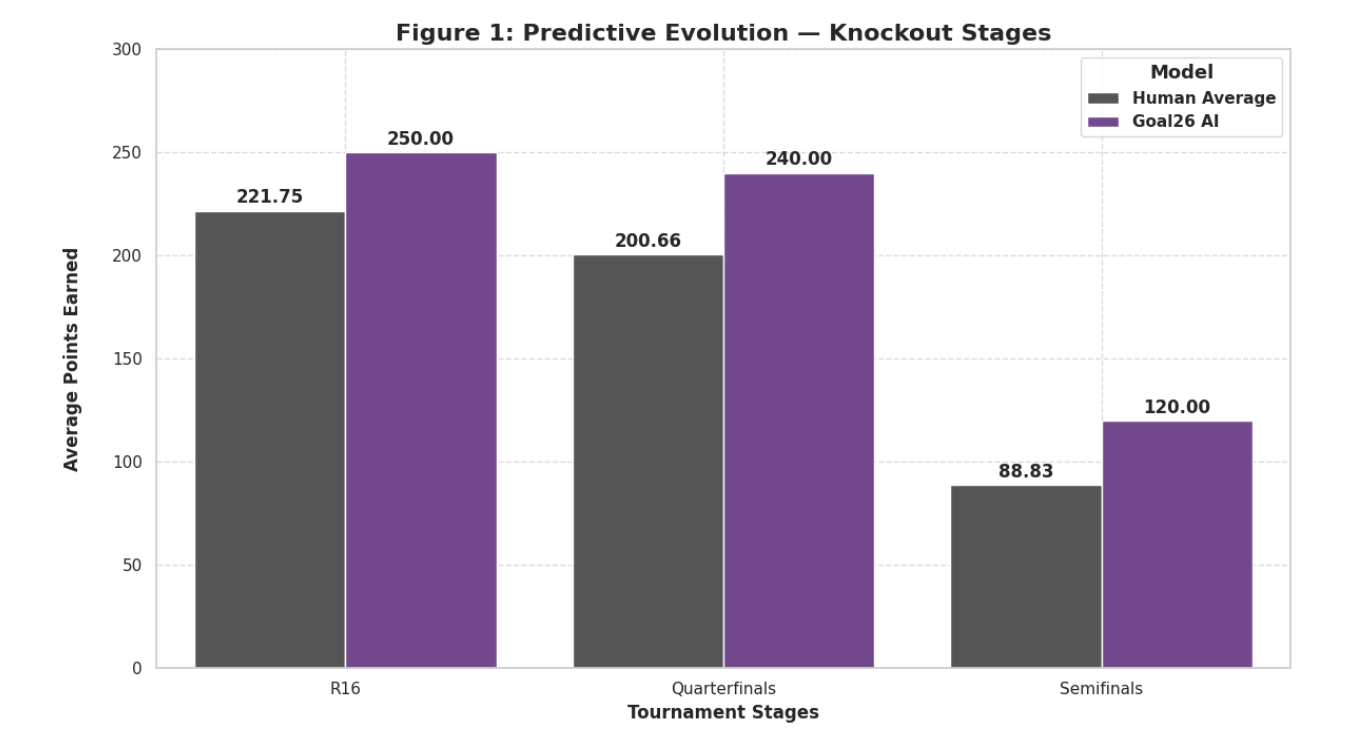
Comparative study finds Goal26's machine learning model outperformed aggregated public predictions in selected FIFA World Cup forecasting measures.
FREMONT, CA, UNITED STATES, July 20, 2026 /EINPresswire.com/ -- Goal26 today announced the publication of new research evaluating the predictive performance of its custom-built machine learning model against more than 50,000 publicly submitted FIFA World Cup 2026 tournament brackets. The study examines how data-driven forecasting compares with large-scale human consensus across multiple stages of one of the world's most widely followed sporting competitions.Conducted in partnership with researcher Riya Deb of Moreau Catholic, the study compared predictions generated by the Goal26 forecasting model with public tournament brackets submitted through WCPredictor. The research was designed to assess the relative performance of statistical machine learning and collective human judgment in tournament forecasting rather than to position one approach as a replacement for the other.
The Goal26 model employs a Random Forest classifier trained on international football match data spanning 1998 through the 2026 FIFA World Cup. To improve predictive accuracy, the model incorporates historical match results, January 2026 FIFA rankings, and a rolling five-match Points Per Game (PPG) metric that measures recent team performance.
Researchers evaluated predictions across the Round of 16, quarterfinals, semifinals, and finalist selections. In addition to measuring prediction accuracy, the study assessed probability calibration using the Brier Score, a widely recognized statistical metric for evaluating the quality of probabilistic forecasts.
According to the published findings, the Goal26 model achieved stronger performance than the aggregated public consensus in selected evaluation categories, particularly knockout-stage forecasting and predictions less influenced by popular team preference. The model also recorded a lower cumulative Brier Score of 0.052, compared with 0.056 for the aggregated human predictions, indicating more consistent probability calibration throughout the tournament.
The comparative evaluation included four primary forecasting categories:
• Fan Support: The Goal26 model correctly projected Portugal's elimination before the semifinals, while many public predictions favored Portugal based on historical reputation and player recognition.
• Knockout Stage Predictions: The model achieved higher cumulative prediction scores across the Round of 16, quarterfinals, and semifinals while recording the stronger Brier Score.
• Strong Team Predictions: Both the Goal26 model and the aggregated public predictions correctly identified Spain, France, and Argentina as likely semifinalists.
• Finalist Predictions: Both forecasting approaches produced partially accurate finalist projections, with each identifying different potential championship matchups.
The researchers emphasize that the findings should not be interpreted as evidence that artificial intelligence consistently outperforms human judgment across all decision-making scenarios. Instead, the study demonstrates how machine learning models can complement traditional sports analysis by identifying historical performance patterns while recognizing that football outcomes remain influenced by injuries, tactical adjustments, player availability, and other unpredictable factors beyond the scope of statistical models.
"Our objective was to evaluate how transparent machine learning methods compare with large-scale human consensus in a real-world forecasting environment," the researcher said. "Rather than replacing human judgment, the study explores where data-driven models can complement traditional sports analysis while contributing to broader discussions surrounding predictive analytics and probability calibration."
The full research paper, "Machine Learning Versus Human Judgment in the 2026 FIFA World Cup: A Comparative Analysis of Over 50,000 Tournament Brackets," details the study's methodology, feature engineering process, statistical evaluation, findings, limitations, and recommendations for future research.
The complete research paper is available on the Goal26 website.
About Goal26
Goal26 is a sports analytics platform focused on applying data science and machine learning to football forecasting. Through predictive modeling and research, Goal26 explores how statistical methods can support tournament forecasting and contribute to ongoing discussions surrounding artificial intelligence, predictive analytics, and sports data science. This comparative study was conducted in collaboration with WCPredictor, which provided the dataset of more than 50,000 publicly submitted tournament brackets used in the analysis.
Research Paper: https://www.goal26.app/article/research-paper-ai-humans
Media Relations
Goal26
email us here
Legal Disclaimer:
EIN Presswire provides this news content "as is" without warranty of any kind. We do not accept any responsibility or liability for the accuracy, content, images, videos, licenses, completeness, legality, or reliability of the information contained in this article. If you have any complaints or copyright issues related to this article, kindly contact the author above.
