

[Latest] Durable Medical Equipment Market Size Expected to Reach USD 370.80 Billion by 2034, With 5.90% CAGR; Rising Prevalence of Chronic Diseases, Home Healthcare Adoption, and Supportive Reimbursement Policies to Propel Market Growth
NEW YORK, USA, July 20, 2026 (GLOBE NEWSWIRE) -- Zion Market Research has published a new research report titled “Durable Medical Equipment Market By Device Type (Personal Mobility Devices, Bathroom Safety Devices & Medical Furniture, Monitoring & Therapeutic Devices), By Mode of Acquisition (Rental, Purchase Source), By Distribution Channel (Hospital & Clinic Pharmacies / DME Suppliers, Retail Pharmacies & DME Stores, Online & Direct-to-Patient Channels), By End-User (Hospitals & Clinics, Home-Healthcare Settings, Ambulatory Surgical Centers, Others), and By Region - Global and Regional Industry Overview, Market Intelligence, Comprehensive Analysis, Historical Data, and Forecasts 2025 - 2034” in its research database.
“According to the latest research study, the global durable medical equipment market size was valued at around USD 234.41 billion in 2024. The market is expected to grow at a CAGR of 5.90% and is anticipated to reach a value of USD 370.80 billion by 2034.”
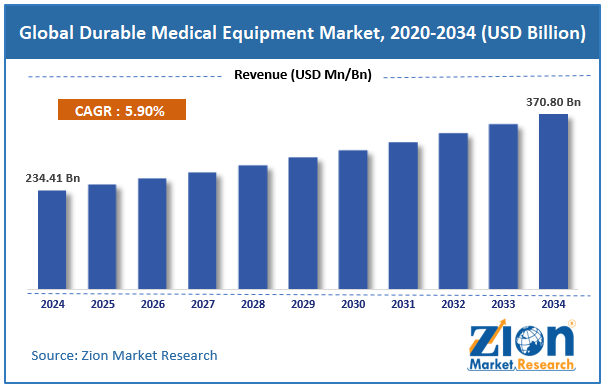
Get a Free Sample PDF of this Research Report for more Insights - https://www.zionmarketresearch.com/sample/durable-medical-equipment-market
Durable Medical Equipment Market Overview:
Durable medical equipment refers to reusable medical devices and assistive tools that certified healthcare professionals specifically prescribe to aid patients in managing long-term physical illnesses or recovering within a non-clinical environment. These products are manufactured to withstand extended, repeated usage and encompass a wide variety of essential items, including oxygen concentrators, automated glucose monitors, customized wheelchairs, specialized hospital beds, and multi-functional walking frames. The overall landscape remains heavily focused on enabling post-treatment rehabilitation, lowering hospital readmissions, and promoting self-reliance among individuals coping with temporary or lifelong physical challenges.
The dynamics governing this market revolve around a combination of systemic demographic shifts and infrastructural evolution across the healthcare sector. The worldwide expansion of the geriatric population serves as a monumental driver, given that older adults exhibit a significantly higher vulnerability to chronic conditions and physical limitations, which directly fuels the continuous adoption of mobility and therapeutic aids. Furthermore, the persistent rise in long-term medical disorders such as severe respiratory issues, diabetes, and cardiovascular diseases requires continuous home-based tracking and care, generating a steady and recurring demand for specialized monitoring systems. On the other hand, the industry is constrained by substantial initial procurement costs for highly sophisticated machinery, coupled with intricate and drawn-out reimbursement approval workflows that frequently cause severe delays in patient access. Despite these limitations, the proactive integration of artificial intelligence and the Internet of Things into newer device lines, along with the rapid scaling of clinical telehealth networks, presents substantial expansion avenues for global manufacturers.
Report Scope:
| Report Attribute | Report Details |
| Market Size in 2024 | USD 234.41 Billion |
| Market Forecast in 2034 | USD 370.80 Billion |
| Growth Rate | CAGR of 5.90% |
| Base Year | 2024 |
| Forecast Years | 2025- 2034 |
| Key Companies Covered | Invacare Corporation, Drive DeVilbiss Healthcare, Medline Industries, Sunrise Medical, Stryker Corporation, Philips Respironics, GE Healthcare, Siemens Healthineers, Fresenius Medical Care, Cardinal Health, 3M Healthcare, Abbott Laboratories, Baxter International, Teleflex Incorporated, Smith+Nephew, and others. |
| Segments Covered | By Device Type, By Mode of Acquisition, By Distribution Channel, By End-User, and By Region |
| Regions Covered | North America, Europe, Asia Pacific, Latin America, and the Middle East & Africa |
| Customization Scope | Avail customized purchase options to meet your exact research needs. |
Directly Purchase a Copy of the Report | Quick Delivery Available - https://www.zionmarketresearch.com/buynow/su/durable-medical-equipment-market
Key Insights from Primary Research
- As per the analysis, the durable medical equipment market share is likely to grow at a CAGR of around 5.90% between 2025 and 2034.
- The durable medical equipment market size was worth around $234.41 billion in 2024 and is estimated to hit approximately $370.80 billion by 2034. Due to a variety of driving factors, the market is predicted to rise at a significant rate.
- The durable medical equipment market is projected to grow significantly, driven by the rising prevalence of chronic diseases, increasing adoption of home healthcare, and government support and reimbursement policies.
- Based on the device type, the personal mobility devices segment accounts for 40% of the total market share, dominating because of the escalating global prevalence of mobility-related impairments and an expanding aging population requiring assistive walking systems.
- Based on the mode of acquisition, the purchase source segment leads with 70% of the total market share, dominated because the majority of patients and clinical entities prefer direct ownership to escape recurring rental fees and secure long-term convenience for perennial conditions.
- Based on the distribution channel, the hospital & clinic pharmacies/DME suppliers segment dominates the market with a 45% share, driven by direct physician prescriptions, seamless institutional sourcing pipelines, and integrated insurance verification networks.
- Based on the end-user, the home-healthcare settings segment leads with 45% market share, dominated due to the shifting paradigm toward home-based long-term treatments, lower clinical costs, and a growing consumer preference for localized therapeutic rehabilitation.
- Based on the regional landscape, the North America region holds the largest market share and is projected to dominate because of its highly structured medical infrastructure, massive public-private healthcare expenditure, and a highly streamlined insurance coverage framework for personal clinical hardware.
Durable Medical Equipment Market: Dynamics
Growth Drivers
- How are government policies and reimbursement favoring the durable medical equipment market?
Supportive governmental mandates and comprehensive public-private insurance reimbursement models act as key catalysts in rendering high-quality medical devices affordable for the general populace. The widespread coverage frameworks spanning essential machinery like therapeutic oxygen systems, blood sugar analyzers, and personalized wheelchairs mitigate extreme out-of-pocket healthcare expenses. These policy incentives emphasize proactive chronic disease management and localized preventative care, which encourages medical institutions to seamlessly prescribe specialized assistive tools.
Consequently, the secured financial returns within established reimbursement architectures give global medical device manufacturers the immense confidence required to scale up production and launch highly innovative portfolios. The standardization of these regulatory frameworks across major nations guarantees a long-term, stable growth environment. This ongoing supportive posture from regional healthcare authorities ensures that vulnerable populations gain rapid, unhindered access to mandatory life-support and ambulatory hardware.
- How is the durable medical equipment market augmented by the growth in surgical and rehabilitation procedures?
The surging volume of complex surgical operations and expanding post-acute physical rehabilitation therapies worldwide are generating a massive requirement for medical equipment. Specialized devices, including lifting hoists, physical therapy aids, and posture-correcting systems, are highly vital in restoring patient autonomy and ensuring safe post-operative transitions. The aggressive build-out of multi-specialty clinical structures across rapidly developing markets further accelerates the volume of incoming surgical procedures.
As healthcare networks prioritize rapid patient turnaround times, the burden of healing processes is systematically shifted from intensive care units to domestic settings and standalone rehab centers. This systematic transition places heavy reliance on durable assistive products to maintain continuous professional-grade care outside conventional clinical environments. This continuous influx of post-surgical recovery patients ensures a highly robust, expanding consumer base for manufacturers globally.
Restraints
- Lack of awareness among end users hinders the market progress
A major impediment restricting the market from realizing its complete potential is the deep-seated lack of technical awareness among home caregivers and patients regarding advanced device choices. A vast number of individuals remain completely oblivious to modern innovations, often harboring severe misconceptions regarding the reliability, operational complexity, and overall cost structures of newer machines. The visible training shortages and technical education gaps within domestic care setups frequently culminate in the serious underutilization or incorrect handling of advanced personal apparatus.
This noticeable knowledge disparity is exceptionally stark within emerging and highly rural regional markets where traditional care practices still overshadow automated clinical solutions. Consequently, medical manufacturers and regional hospital groups are forced to expend an extensive amount of operational capital on basic education programs. Until these informational gaps are bridged, a huge portion of highly advanced, high-margin therapeutic machinery will continue to experience low market penetration.
Opportunities
- How are technological integration and the use of smart devices advantageous for the development of the durable medical equipment market?
The seamless integration of the Internet of Things (IoT), sophisticated artificial intelligence (AI) algorithms, and cloud-connected sensors into medical equipment presents a massive expansion landscape. These structural upgrades enable critical features like predictive component maintenance, real-time wireless physiological tracking, and instantaneous diagnostic data reporting directly to remote physicians. Aligning these advanced machines with rapidly growing corporate telehealth networks immensely amplifies their day-to-day healthcare utility and maximizes direct patient compliance.
Smart medical machinery plays a profound role in identifying early biological degradation, thereby dramatically reducing costly emergency hospital readmissions. This technological transition allows leading manufacturers to introduce high-value, premium product tiers that provide unmatched health tracking accuracy. As demand for patient-centric digital healthcare solutions intensifies, these intelligent medical tools will command significant market premiums and tap into brand-new consumer segments.
Challenges
- Rapid technological obsolescence restricts market growth
The blistering pace of technological evolution in the digital health domain introduces a severe challenge in the form of rapid product obsolescence, frequently rendering older devices uncompetitive within short cycles. Individual patients and large hospital networks are highly hesitant to commit substantial capital to premium equipment lines out of fear that the systems will become outdated within a few months. Furthermore, older physical equipment configurations often face severe compatibility issues when integrated with newly upgraded healthcare software systems or modern communication networks.
This rapid pace of innovation forces manufacturers to constantly re-engineer their product frameworks, which drives up research and development expenditures while drastically shrinking product commercialization windows. Companies face immense strategic stress in providing advanced features while simultaneously maintaining backward compatibility for their legacy user bases. Managing this fine balance between durable structural engineering and rapid software-driven upgrades remains a critical pain point for all players.
Browse the full “Durable Medical Equipment Market By Device Type (Personal Mobility Devices, Bathroom Safety Devices & Medical Furniture, Monitoring & Therapeutic Devices), By Mode of Acquisition (Rental, Purchase Source), By Distribution Channel (Hospital & Clinic Pharmacies / DME Suppliers, Retail Pharmacies & DME Stores, Online & Direct-to-Patient Channels), By End-User (Hospitals & Clinics, Home-Healthcare Settings, Ambulatory Surgical Centers, Others), and By Region - Global and Regional Industry Overview, Market Intelligence, Comprehensive Analysis, Historical Data, and Forecasts 2025 - 2034” Report at https://www.zionmarketresearch.com/report/durable-medical-equipment-market
Durable Medical Equipment Market: Segmentation
The global durable medical equipment market is segmented by device type, mode of acquisition, distribution channel, end-user industry, and region.
Based on device type, the durable medical equipment market is divided into personal mobility devices, bathroom safety devices & medical furniture, and monitoring & therapeutic devices. The personal mobility devices segment represents the most dominant market force, capturing 40% of the overall market revenue due to a rapidly aging global population and an increasing incidence of age-related physical disabilities that necessitate wheelchairs and walking frames. The monitoring & therapeutic devices segment stands out as the second most dominant category, securing 30% of the market share, as the escalating global burden of chronic cardiovascular and respiratory diseases requires continuous clinical tracking tools within residential spaces.
Based on the mode of acquisition, the durable medical equipment market is divided into rental and purchase sources. The purchase source segment represents the absolute dominant mode, accounting for 70% of the global market share because patients and medical providers strongly prefer outright equipment ownership to completely eliminate long-term recurring lease payments and secure constant, immediate hardware access for chronic medical conditions. The rental segment functions as the second most dominant segment, commanding a 30% share of the industry value, driven by short-term post-operative recovery needs and the temporary requirement of exceptionally high-priced specialized machinery like advanced oxygen concentrators.
Based on distribution channel, the durable medical equipment market is divided into hospital & clinic pharmacies / DME suppliers, retail pharmacies & DME stores, and online & direct-to-patient channels. The hospital & clinic pharmacies / DME suppliers segment is the most dominant channel, capturing 45% of the market because the vast majority of medical hardware is directly prescribed during clinical visits, enabling seamless insurance navigation and professional equipment calibration within the institutional setting. The retail pharmacies & DME stores segment is the second most dominant channel, holding a 35% market share by providing immediate physical access, over-the-counter ease, and localized product selection for standard mobility and safety equipment.
Based on end-user, the durable medical equipment market is divided into hospitals & clinics, home-healthcare settings, ambulatory surgical centers, and others. The home-healthcare settings segment holds the premier dominant position with a 45% market share, heavily propelled by the shifting healthcare preference toward low-cost domestic recovery options and the growing base of elderly individuals requiring continuous long-term home nursing assistance. The hospitals & clinics segment forms the second most dominant end-user division, commanding a 35% market share due to the continuous necessity of replenishing high-grade clinical beds, patient lifters, and inpatient monitoring tools across their multi-ward setups.
Regional Scope:
- Why will North America continue to dominate the global market during the projection period?
North America stands at the absolute forefront of the global industry and is firmly positioned to maintain its leading posture throughout the forecast timeline due to its expansive, cutting-edge healthcare architecture and highly robust public and private healthcare funding mechanisms. The United States acts as the primary driver of this regional dominance, characterized by the exceptionally rapid integration of sophisticated digital health technologies and smart medical hardware across its clinical and domestic care sectors. Furthermore, the region boasts an incredibly high concentration of prominent medical device manufacturers, which ensures immediate regional availability of next-generation healthcare equipment. The presence of comprehensive insurance coverage frameworks, particularly for long-term home-use medical apparatus, significantly lowers financial entry barriers for the local population. This systematic financial backing, combined with a rapidly expanding senior demographic that increasingly chooses home-based clinical care, ensures a steady, high-volume flow of device procurement that far outpaces other international territories.
Europe commands the position of the second-largest regional market, driven by highly institutionalized healthcare frameworks and extensive social security systems across prominent Western European nations. The region experiences heavy demand for assistive mobility and advanced home monitoring systems, backed by proactive state funding aimed at reducing the physical burden on central hospital infrastructure. In the Asia Pacific region, growth is accelerating rapidly, spearheaded by massive healthcare infrastructure upgrades and expanding middle-class populations in major countries. The expanding local manufacturing bases and favorable government initiatives aimed at upgrading rural medical accessibility are setting the stage for long-term expansion. Latin America exhibits steady progress, supported by gradual regulatory overhauls and a rising demand for low-cost refurbished clinical systems across urban centers. Meanwhile, the Middle East and Africa region is witnessing selective growth, heavily concentrated within advanced metropolitan hubs that are actively investing in cutting-edge clinical infrastructure and specialized rehabilitation centers.
Recent Developments
- In January 2026, a major medical device corporation finalized the strategic acquisition of a specialized digital health monitoring firm to integrate cloud-connected artificial intelligence diagnostics directly into its next-generation home-based respiratory ventilation systems.
- In October 2025, a premier mobility solutions provider announced the official commercial launch of a highly advanced, ultra-lightweight carbon fiber power wheelchair featuring integrated IoT telematics for real-time tracking of patient usage metrics and predictive battery performance.
- In May 2025, a leading healthcare manufacturing enterprise entered into a long-term partnership with a global logistics network to streamline direct-to-patient fulfillment processes and establish a rapid, automated distribution model for home-healthcare equipment.
Request For Customization on This Report as Per Your Requirements - https://www.zionmarketresearch.com/custom/10257
Durable Medical Equipment Market: Competitive Landscape
The report contains qualitative and quantitative research on the global durable medical equipment market, as well as detailed insights and development strategies employed by the leading competitors.
Some of the main players in the global durable medical equipment market include;
- Invacare Corporation
- Drive DeVilbiss Healthcare
- Medline Industries
- Sunrise Medical
- Stryker Corporation
- Philips Respironics
- GE Healthcare
- Siemens Healthineers
- Fresenius Medical Care
- Cardinal Health
- 3M Healthcare
- Abbott Laboratories
- Baxter International
- Teleflex Incorporated
- Smith+Nephew
What are the key trends in the Durable Medical Equipment Market?
- Rapid Integration of Artificial Intelligence and IoT Telematics into Home-Care Devices
The global market is witnessing an extensive paradigm shift characterized by the inclusion of smart sensors, cellular connectivity, and machine learning models within standard patient monitoring and mobility systems. This technological trend enables personal devices to continuously capture vital biometrics, automatically detect mechanical errors, and instantly transmit operational data logs directly to clinical databases. This digital transformation vastly improves user treatment compliance, offers predictive device maintenance capabilities, and empowers healthcare providers to intervene proactively before a major clinical emergency occurs.
- Broad Structural Transition Toward Decentralized and Direct-to-Patient Distribution Channels
Another prominent industry trend is the rapid expansion of direct-to-patient online commerce platforms and specialized home-delivery logistics networks, reducing reliance on conventional brick-and-mortar medical storefronts. Manufacturers are increasingly bypassing traditional supply chains to build highly agile, digital procurement portals that allow consumers to upload prescriptions and secure automated insurance authorizations easily. This ongoing channel evolution significantly enhances the speed of device acquisition, lowers structural operational overheads, and meets the rising consumer demand for convenient home-step delivery models.
The global durable medical equipment market is segmented as follows:
By Device Type
- Personal Mobility Devices
- Bathroom Safety Devices & Medical Furniture
- Monitoring & Therapeutic Devices
By Mode of Acquisition
- Rental
- Purchase Source
By Distribution Channel
- Hospital & Clinic Pharmacies / DME Suppliers
- Retail Pharmacies & DME Stores
- Online & Direct-to-Patient Channels
By End-User
- Hospitals & Clinics
- Home-Healthcare Settings
- Ambulatory Surgical Centers
- Others
By Region
- North America
- The U.S.
- Canada
- Europe
- France
- The UK
- Spain
- Germany
- Italy
- Rest of Europe
- Asia Pacific
- China
- Japan
- India
- Southeast Asia
- Rest of Southeast Asia
- The Middle East & Africa
- GCC
- South Africa
- Rest of the Middle East & Africa
- Latin America
- Brazil
- Argentina
- Rest of Latin America
Request Free Brochure of the Global Durable Medical Equipment Market @ https://www.zionmarketresearch.com/requestbrochure/durable-medical-equipment-market
Key Questions Answered in This Report:
- What is durable medical equipment?
- Which key factors will influence the durable medical equipment market growth over 2025-2034?
- What will be the value of the durable medical equipment market during 2025-2034?
- What will be the CAGR of the durable medical equipment market during 2025-2034?
- How will macroeconomic factors impact the durable medical equipment market in the coming years?
- Which region will contribute notably to the durable medical equipment market value?
- Which country is a significant contributor to the global durable medical equipment market?
- Which are the major players driving growth in the durable medical equipment market?
- What strategic initiatives are leading players adopting to expand their market presence?
- What can be expected from the global durable medical equipment market report?
Browse Other Related Research Reports from Zion Market Research
- Wearable Medical Device Market Size, Share, Trends, By Device Type (Diagnostic Devices, Therapeutic Devices, Drug Delivery Devices), By Application (Remote Patient Monitoring, Sports & Fitness, Home Healthcare, Chronic Disease Management), By End User (Hospitals & Clinics, Homecare Settings, Sports & Fitness Centres, Research Institutions), By Connectivity Technology (Bluetooth, Wi-Fi, NFC, Cellular), By Region, and Forecast 2026 - 2034
- Lung Stent Market By Product Type (Silicone Stents, Metal Stents, Hybrid Stents, and Biodegradable Stents), By Indication (Malignant Airway Obstruction, Benign Airway Stenosis, Tracheobronchomalacia, Fistulas and Perforations, and Post-Transplant Complications), By End User (Hospitals, Ambulatory Surgical Centers, Specialty Clinics, and Academic & Research Institutions), By Material (Nitinol, Stainless Steel, Silicone, Polyurethane, and Biodegradable Polymers), and By Region -Global and Regional Industry Overview, Market Intelligence, Comprehensive Analysis, Historical Data, and Forecasts 2025 - 2034
- Dermatology Diagnostic Devices Market By Type (Handheld Devices, Imaging Systems, and Laboratory Diagnostic Devices), By Technology (Optical Coherence Tomography (OCT), Dermoscopy, Ultrasound Imaging, Confocal Microscopy, and Molecular & Genetic Diagnostic Techniques), By Application (Hospitals & Clinics, Dermatology Centers, and Diagnostic Laboratories), and By Region - Global and Regional Industry Overview, Market Intelligence, Comprehensive Analysis, Historical Data, and Forecasts 2025 - 2034
- Home Ventilator Market By Type (Invasive Ventilators and Non-Invasive Ventilators), By Mode (Pressure-Controlled, Volume-Controlled, and Hybrid), By Application (Chronic Obstructive Pulmonary Disease, Sleep Apnea, Neuromuscular Disorders, Post-Acute Care, and Others), and By Region – Global and Regional Industry Overview, Market Intelligence, Comprehensive Analysis, Historical Data, and Forecasts 2025 - 2034-
- Laboratory Plasticware Market By Material (Polystyrene, High-Density Polyethylene (HDPE), Low-Density Polyethylene (LDPE), Polymethylpentene (PMP), Polyvinyl Chloride (PVC), and Others), By End-User (Pharmaceutical & Biotechnology Companies, Diagnostic Centers, Research & Academic Institutes, Hospitals, and Others), and By Region - Global and Regional Industry Overview, Market Intelligence, Comprehensive Analysis, Historical Data, and Forecasts 2025 - 2034
About Zion Market Research:
Zion Market Research is a leading market research organization offering industry expertise and scrupulous consulting services to clients for their business development. The reports and services offered by Zion Market Research are used by prestigious academic institutions, start-ups, and companies globally to measure and understand the changing international and regional business backgrounds.
Contact Us:
Zion Market Research
USA/Canada Toll Free: 1 (855) 465-4651 | Newark: 1 (302) 444-0166
India: +91 7768 006 007 | +91 7768 006 008
Email: sales@zionmarketresearch.com | Web: https://www.zionmarketresearch.com/
Follow Us on - LinkedIn | X | Facebook | Pinterest | YouTube


Legal Disclaimer:
EIN Presswire provides this news content "as is" without warranty of any kind. We do not accept any responsibility or liability for the accuracy, content, images, videos, licenses, completeness, legality, or reliability of the information contained in this article. If you have any complaints or copyright issues related to this article, kindly contact the author above.
